The Megawatt Is Easy. The Commitment Is Hard.
Four months ago, I framed the AI infrastructure challenge as “30-Year Steel vs. 10-Year Silicon.” The underlying risk remains—but the mechanism is becoming clearer.
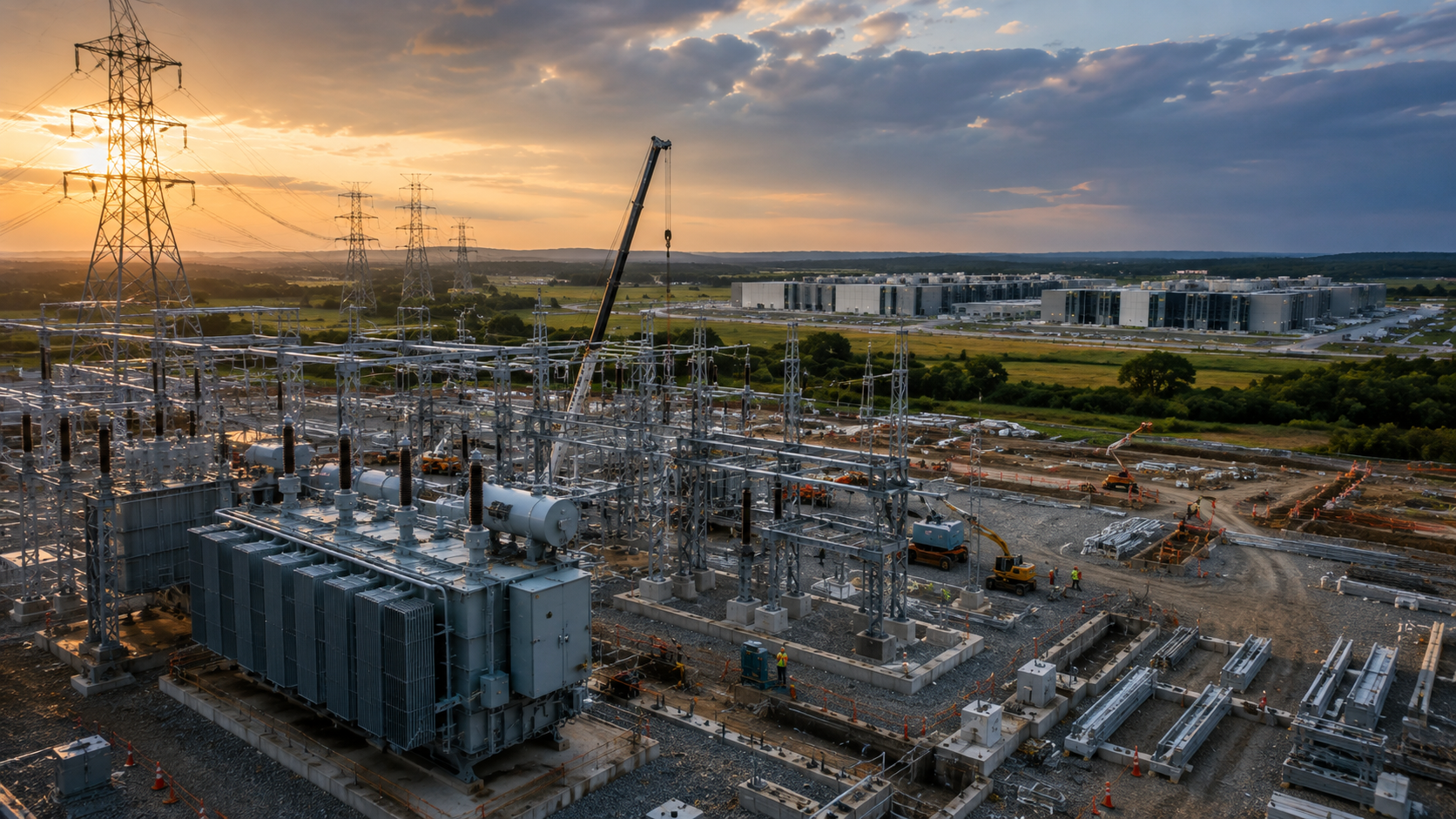
The infrastructure may last for decades. The question is whether the commitment behind the load is durable enough to justify it.
Why This Matters
Electricity demand is accelerating at a pace the industry has not confronted in decades.
Data centers, advanced manufacturing and other large loads are forcing utilities to make decisions about generation, transmission and distribution infrastructure that can remain in service—and in the rate base—for decades.
That creates an obvious temptation to frame the problem as a race to build.
I think the harder question comes one step earlier:
At what point should an uncertain megawatt be allowed to become a durable capital obligation—and what must be true before it does?
That distinction matters because the consequences of getting the forecast wrong are not symmetrical.
If a utility waits too long to build for credible demand, reliability and economic development can suffer.
If it commits too early against demand that does not materialize—or under financial terms that do not adequately support the investment—the steel can remain long after the economic assumption behind it has changed.
The challenge is not simply whether to build.
It is knowing when the megawatt is real enough to justify the capital.
The Signal
Earlier this year, I described this problem as “30-Year Steel vs. 10-Year Silicon.”
The premise was straightforward: utilities were being asked to consider long-lived infrastructure commitments against an AI technology and investment cycle moving considerably faster than the assets required to power it.
After several more months of watching the market, regulatory proceedings and utility responses—and after deliberately trying to break that thesis—I would frame it differently today.
The useful life of the silicon is not the controlling clock.
A data center can replace multiple generations of GPUs and remain a substantial electric customer. A transmission asset can outlive the customer that originally helped justify it and still provide considerable system value. And a new large load can improve system economics if its revenues exceed the incremental costs required to serve it.
The more durable mismatch is between capital and commitment.
Long-lived infrastructure becomes vulnerable when the certainty of the load, the durability of the revenue supporting it, the customer's enforceable financial obligation and the reusable value of the asset do not adequately match the capital being committed.
And increasingly, the industry appears to be responding to it.
From Paper Megawatts to Financial Megawatts
A megawatt in a development pipeline is not necessarily a megawatt worth building around.
Utilities have long understood forecast uncertainty. What is different about the current cycle is the scale, concentration and speed of some large-load requests.
That has made the quality of the demand signal increasingly important.
AEP Ohio provides one of the clearest examples.
Before its new process was applied, data-center requests exceeded 30,000 MW. Of that prospective load, customers representing 13,022.7 MW proceeded with and paid for formal engineering studies, allowing AEP to develop service plans identifying the infrastructure and collateral requirements associated with serving them. When the process reached binding service agreements backed by collateral, 5,642 MW signed under the new tariff.
That progression should not be interpreted to mean every megawatt that failed to advance was speculative. Projects change for many reasons.
But it demonstrates something important: the amount of prospective load changed materially as the financial and legal commitment behind it increased.
AEP's tariff requires qualifying customers to make substantially harder commitments behind requested capacity, including minimum-demand obligations and, depending on credit quality, substantial collateral.
The significance is larger than the tariff itself.
When developers have to put meaningful financial obligations behind requested megawatts, the utility gains a better basis for distinguishing potential demand from committed demand.
That is not merely a billing issue.
It is a planning tool.
And it points toward a principle that may become increasingly important across the industry:
Before uncertain megawatts become durable capital obligations, the financial commitment behind them should become correspondingly durable.
We are already seeing variations of that principle elsewhere.
AES Indiana's proposed agreement to serve Google's Monrovia project incorporates minimum-demand commitments, financial assurances and exit protections while assigning the incremental energy and infrastructure costs associated with the project to the customer. AES says the customer-specific contract runs for at least 15 years and projects more than $770 million in benefits for existing customers over that period. The agreement remains subject to regulatory approval, so those projected protections and benefits should not yet be treated as adjudicated outcomes.
Entergy Louisiana's arrangements around major Meta-related development take the concept further. Public filings describe mechanisms including contributions in aid of construction, advance payments, minimum monthly bills, collateral and obligations tied to Entergy Louisiana's unrecovered incremental utility investment if the project terminates, restructures or defaults.
Different jurisdictions. Different utilities. Different structures.
But the underlying question is increasingly similar:
How much durable utility capital should be placed behind a customer whose durable financial commitment has not yet caught up with its requested load?
The Ground-to-Grid Perspective
This is where the original Steel-versus-Silicon framing needs another refinement.
Not all steel carries the same risk.
Consider two hypothetical 30-year assets.
One is highly specific to a single large customer, has limited alternative use and depends heavily on that customer's continued presence for economic recovery.
The other strengthens a constrained part of the grid, serves multiple customers and retains substantial system value even if the original load forecast changes.
They may have identical accounting lives.
They do not have identical risk.
That means asset life by itself tells an executive surprisingly little.
The more useful questions are:
How credible is the load?
How durable is the revenue obligation?
How reusable is the asset?
Who holds the unrecovered exposure if the assumptions change?
Those questions connect customer development, load forecasting, generation, transmission, fuel supply, utility finance, regulation and capital recovery.
That is the Ground-to-Grid problem.
The Industry Is Already Moving
The most important development since my original analysis may not be a failed data center or a stranded power plant.
It may be the institutional response occurring before those outcomes become widespread.
In June, FERC opened separate proceedings involving each of the six regional grid operators under its jurisdiction, directing them to justify or reform rules governing the integration of data centers and other large loads. The Commission placed consumer protection, reliability, transparency and innovation alongside the need for speed-to-power.
That matters.
But it requires careful interpretation.
The emergence of protective tariffs and regulatory safeguards does not prove that AI-driven stranded assets have already become a widespread problem.
I have not found evidence sufficient to make that claim.
Nor have I found a mature, broadly representative case completing the entire chain from speculative AI load, to dedicated infrastructure construction, to customer departure, to unusable asset, to demonstrated cost transfer onto ordinary ratepayers.
The risk remains substantially prospective.
But the industry's response tells us something else.
Utilities and regulators consider the exposure credible enough to change how large loads are screened, contracted, studied and ultimately served.
And if those protections work, they may prevent some of the very outcomes they were designed to address.
That is not evidence the risk was imaginary.
It is evidence that risk management can change the outcome.
The Other Side of the Equation
There is another conclusion that deserves equal attention.
Large-load growth is not inherently a ratepayer liability.
If the customer pays the incremental cost of serving its demand, provides sufficiently durable financial support, and the infrastructure created has broader system value, additional load can contribute revenue toward a utility's fixed costs and potentially improve economics for other customers.
AES Indiana, for example, currently projects more than $770 million in benefits for existing customers from its proposed Google agreement over 15 years. That remains a company projection subject to regulatory review—not an established outcome—but it illustrates the other side of the economic equation.
That possibility is important because it prevents this discussion from collapsing into a false choice between “build everything” and “AI is a bubble—build nothing.”
Neither is a serious infrastructure strategy.
A new gas plant is not inherently a stranded asset because a data center contributed to the need for it.
A transmission project is not inherently prudent because somebody forecasted several gigawatts of future demand.
An existing generating asset is not inherently economical merely because it is already built.
The question is whether the physical asset, timing, customer obligation and recovery mechanism fit together.
That is a much higher bar than simply asking whether electricity demand is growing.
A Different Test: The Vertically Integrated Utility
The Carolinas may provide an especially useful test.
Duke Energy's vertically integrated utility structure provides a useful contrast to the RTO examples. Load forecasting, generation, transmission, distribution and regulatory recovery sit within a more directly integrated planning framework.
That integration could be an advantage.
A utility capable of coordinating the entire chain may have more tools to stage investment, retain optionality and redirect infrastructure toward broader system needs if individual customer assumptions change.
But integration does not make forecasting risk disappear.
If a large-load assumption is wrong, the same assumption can potentially influence multiple layers of the capital plan.
That leaves an important question:
Does vertical integration make large-load capital risk easier to manage—or simply place more of the planning chain behind the same forecast?
The answer is still developing.
That makes the Carolinas a test, not a conclusion.
What to Watch
The next phase of the AI power buildout should be judged by more than announcements of gigawatts, power plants and transmission projects.
Watch what happens before construction.
Watch whether utilities distinguish requested load from financially committed load.
Watch contract duration relative to capital exposure.
Watch minimum-payment provisions, collateral, customer contributions and termination obligations.
Watch whether infrastructure is customer-specific or retains broader system value.
Watch whether utilities stage investments as load certainty improves—or commit ahead of it.
And watch who ultimately holds the residual risk.
Because the strategic danger may not be that America builds too much infrastructure.
It may be that we build the wrong assets, at the wrong time, under financial terms that leave the wrong party holding the tail risk.
Four months ago, I called that 30-Year Steel vs. 10-Year Silicon.
I would describe it differently today.
The megawatt may be easy to request. The commitment behind it should determine when the steel follows.
SELECTED PRIMARY SOURCES
AEP Ohio — Data Center Tariff Implementation Update, February 13, 2026
AEP Ohio's implementation update covering the progression of prospective data-center load through formal engineering studies, service planning, collateral requirements and binding agreements.
View AEP Ohio primary source
AES — Monrovia Large Load Customer Project, SEC disclosure
AES's SEC-filed disclosure concerning the proposed Google-related project, including financial assurances, minimum-demand commitments, exit provisions and AES's projected customer benefits.
View AES SEC filing
Entergy — Form 10-Q, June 30, 2026
SEC-filed disclosure describing large-load arrangements including contributions in aid of construction, advance payments, minimum monthly bills, unrecovered-cost obligations and collateral protections.
View Entergy SEC filing
Federal Energy Regulatory Commission — Large Load Integration Proceedings, June 18, 2026
FERC's announcement of separate proceedings involving each of the six regional grid operators under its jurisdiction.
View FERC primary source
FERC Commissioner David Rosner — Large Load Show Cause Orders, June 18, 2026
Commissioner Rosner's explanation of the consumer-protection and cost-recovery rationale associated with the Commission's large-load proceedings.
View Commissioner Rosner's remarks
DISCLAIMER
Phoenix Intelligence provides strategic advisory products that are developed from three decades of ground-to-grid operational experience across the energy value chain and are intended to identify emerging structural risks, hidden market distortions, and second-order consequences before they become widely recognized.
Phoenix Intelligence briefings are not forensic investigations, engineering studies, regulatory findings, or investment recommendations. Readers should evaluate these briefings as industry perspectives and opinions of the author which are intended to provoke executive consideration, challenge conventional assumptions, and support strategic preparedness.
Artificial intelligence tools may be used to assist with research, source analysis, and the development of these briefings; the interpretations, judgments, and conclusions presented remain those of the author.